Medical Negligence FAQs

The effects of medical negligence are often profound and life-changing for the victim. If you’ve suffered harm due to substandard care from a healthcare provider in Ireland, it’s natural to have questions. In this guide, we’ll cover some of the most frequently asked questions we receive about medical negligence, including what it means, how claims work and what legal supports are available.
What is Medical Negligence?
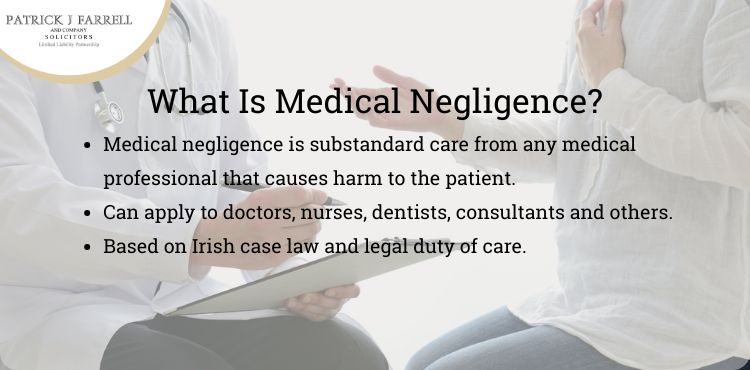
Medical negligence happens when a healthcare professional fails to provide the standard of care expected in their role, and that failure causes injury, harm or worsens a patient’s condition.
This could involve a misdiagnosis, surgical mistake, delayed treatment, incorrect medication or even substandard aftercare. The key issue is to determine whether another competent professional would have acted differently in the same situation.
Under Irish law, proving negligence requires showing that:
- A duty of care existed,
- That duty was breached,
- And the breach directly caused the harm suffered.
How Do I Know If I Have a Claim?
Many people are unsure if what happened to them amounts to negligence, or if it was simply an unfortunate outcome. However, the law sets out specific criteria to help distinguish between the two, and understanding these can help clarify your situation.
To bring a successful medical negligence claim in Ireland, four elements must be established:
- Duty of Care: The provider had a responsibility to care for you.
- Breach: They failed to meet a reasonable standard.
- Causation: That failure directly caused your injury or condition.
- Damages: You suffered a loss, such as physical, emotional, financial.
Your solicitor will often work with medical experts to assess that your case meets the above criteria to make a successful claim.
What Are Common Examples of Medical Negligence?
Medical negligence can happen in many different ways, across a range of healthcare settings.
Some cases are obvious, like surgical errors, while others may be more subtle such as a delayed diagnosis that leads to a condition worsening over time. Recognising the different forms of negligence helps you understand whether what happened to you might meet the legal threshold for a claim.
- Misdiagnosis or delayed diagnosis of conditions like cancer.
- Surgical errors, such as leaving instruments behind.
- Birth injuries to the child or mother.
- Prescription mistakes, like the wrong dosage.
- Failure to monitor a patient after surgery or during labour.
- Lack of informed consent for procedures.
How Long Do I Have To Bring A Claim?
In Ireland, the general rule is that you must bring a medical negligence claim within two years from the date you knew, or ought to have known, you were injured due to negligent care. This is set out in the Statute of Limitations Act 1957.
There are some exceptions:
- Children: The two-year time limit starts on their 18th birthday.
- Mental Capacity: The clock may not start if the person lacks capacity.
- Delayed Discovery: If you didn’t realise you were injured until later.
Generally speaking, it’s best to act quickly as building a medical negligence case can take some time, and you will need to gather documents such as medical records and expert opinion to support your case.
What Does The Claims Process Involve?
The idea of making a legal claim might feel overwhelming at first, especially if you’re still recovering from what happened. But the process is structured and step-by-step, with your solicitor handling most of the work. Understanding the stages can help you feel more confident in moving forward.
A typical medical negligence claim includes:
- Initial Consultation: You speak with a solicitor to outline what happened.
- Medical Records: These are requested and reviewed.
- Expert Opinion: A medical expert assesses whether negligence occurred.
- Letter of Claim : If negligence is found, a formal letter is sent to the provider.
- Negotiation: The defendant may accept liability or challenge it.
- Legal proceedings: If no settlement is reached, a case may go to the High Court.
Will I Need to Go to Court?
Not necessarily. Many medical negligence claims in Ireland settle out of court. If the other side accepts liability, a compensation agreement may be reached through negotiation or mediation.
However, if liability is denied or the parties can’t agree on compensation, your solicitor may recommend taking the case to court. In Ireland, these cases typically go before the High Court.
What Compensation Can I Receive?
If your claim is successful, compensation (also known as damages) is intended to help you recover or manage the consequences of the harm caused. It’s not about profiting, it’s about fairness. The amount depends on how serious your injuries are and how they affect your life going forward.
You may be entitled to:
- General damages: Pain, suffering, and loss of quality of life.
- Special Damages: Medical bills, travel costs, and lost income.
- Future Care Needs: Ongoing treatment or home assistance.
The amount awarded varies based on the severity of the injury, impact on your life, and supporting evidence. In 2021, Ireland introduced a new Personal Injuries Guidelines system to help assess fair compensation amounts and achieve greater consistency in awards.
Can I Bring a Claim for Someone Else?
In certain circumstances, a person affected by medical negligence may not be able to bring the claim themselves. In those situations, another person, usually a family member, can act on their behalf. This is called bringing a claim as a “next friend” or legal representative.
Common situations include:
- Parents can bring claims on behalf of children.
- Next of kin can pursue a wrongful death claim.
- Legal guardians or representatives can act for those with reduced capacity.
You will need to prove you have the authority to act on someone else’s behalf, like a birth certificate, death certificate or power of attorney.
We are here to help.
Medical negligence is serious and can often be complicated, but help is available. If you’ve suffered due to substandard medical care, don’t wait. The earlier you act, the better your chances of securing fair compensation and moving forward.
At Patrick J Farrell & Co Solicitors, we’ve helped many individuals and families across Ireland understand their rights and pursue claims after receiving poor medical care. For personal advice and legal support, contact one of our medical negligence experts. We can help you understand your rights and take the next steps with confidence and discretion.

Helen Coughlan
Medical Negligence Solicitor
Helen Coughlan is a partner and advises on medical negligence*, family law and personal injuries*. Helen is a qualified family mediator and collaborative law practitioner and is Chairperson of the Family and Child Law Committee of the Law Society.

Emma Farrell
Medical Negligence Solicitor
Emma Farrell is a partner and advises on medical negligence* and personal injuries*. She qualified with the largest solicitors’ firm in Ireland and has significant expertise.
© Patrick J Farrell and Company LLP, Solicitors. All rights reserved. Web Design & Web Development by Acton Web.


