Dental Negligence in Ireland: Your Legal Rights
As with all medical practices and treatments in Ireland, Dental care is expected to meet professional standards.
But when a dentist or dental professional makes a mistake, the consequences can be serious and cause side-effects ranging from persistent pain to long-term damage or financial hardship.
Dental negligence is a form of medical negligence, if you’ve experienced poor dental care that led to harm, you may have grounds for a dental negligence claim.
This guide explains what dental negligence is, how to tell if you have a valid case, what the legal process involves, and where to get support. We’ve written this with patients in mind, especially those unsure of where to start after something goes wrong.
Dental negligence refers to any situation where a dental professional fails to meet the expected standard of care, and that failure results in harm to the patient. In Ireland, dentists, orthodontists, hygienists, and oral surgeons all have a legal duty to provide care that meets professional and clinical standards.
Negligence can occur during diagnosis, treatment, or even during follow-up care. It’s not limited to surgical procedures, x-rays, or cosmetic work like veneers; even simple procedures such as routine cleanings or whitening can also result in a claim if the care is clearly substandard.
The law looks at what a competent dental professional would have done in the same situation.
Whether your treatment was public or private, the same basic principle applies: if the dentist’s care caused you harm and they failed to act as a reasonably competent provider would, you may be entitled to bring a legal claim.
Common types of dental negligence include:
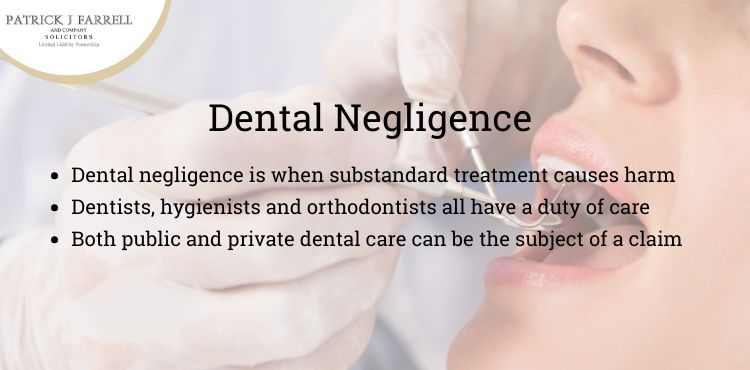
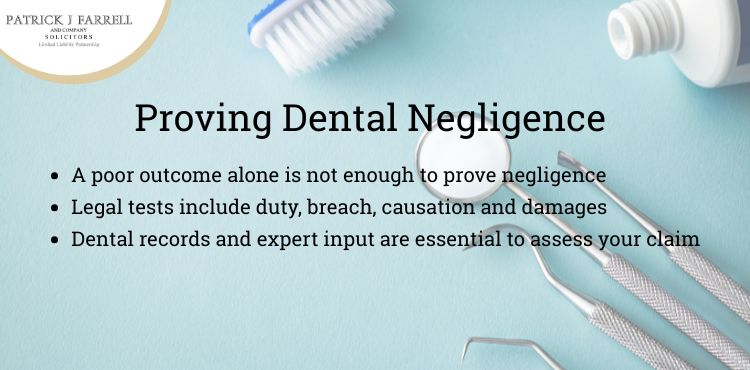
It’s not always clear whether what happened to you counts as dental negligence. You might feel something wasn’t right, but proving negligence in a legal sense involves meeting a specific standard. In Ireland, it’s not enough to show that the outcome was poor or disappointing, you must show that your care fell below a reasonable standard and that this directly caused your injury.
A claim typically relies on four legal elements: duty of care, breach of duty, causation, and damages. A solicitor will work with you to determine if each of these applies in your case. They may request dental records, consult with an independent dental expert, and evaluate whether the dentist acted in a way that another competent professional would not have.
In many cases, patients only realise negligence occurred after seeking corrective treatment elsewhere or when their condition worsens over time. That’s why it’s important to seek legal advice early, even if you’re not sure whether you want to pursue a claim.
Dental negligence can take many forms, and it doesn’t always involve dramatic or obvious mistakes. Sometimes, it’s about what wasn’t done, such as failing to identify an infection or delaying a referral to a specialist. In other cases, it’s due to an active error, like removing the wrong tooth or causing lasting nerve damage.
It’s also increasingly common for claims to arise from cosmetic dentistry, where patients undergo elective treatments and experience unsatisfactory or harmful outcomes. Since cosmetic procedures are often irreversible, the effects can be both physical and emotional. Claims may also stem from unsanitary practices or failure to maintain proper hygiene in a dental clinic.
If you’re unsure whether your experience qualifies, you can ask another dental professional for an opinion or speak to a solicitor for a case review.
Examples of dental mispractice may include:
In Ireland, the law gives you a limited window to bring a personal injury claim, including dental negligence. The standard time limit is two years from the date of knowledge; that is, when you became aware (or reasonably should have been aware) that your injury was caused by negligent dental treatment.
This doesn’t always mean the date of the treatment itself. Sometimes the effects of poor care aren’t obvious until months later, especially if symptoms develop slowly or after further complications. That’s why the “date of knowledge” is so important in determining your deadline.
Some exceptions exist. For children, the two-year period doesn’t begin until their 18th birthday. For people with impaired mental capacity, the time limit may not begin at all unless capacity is regained.
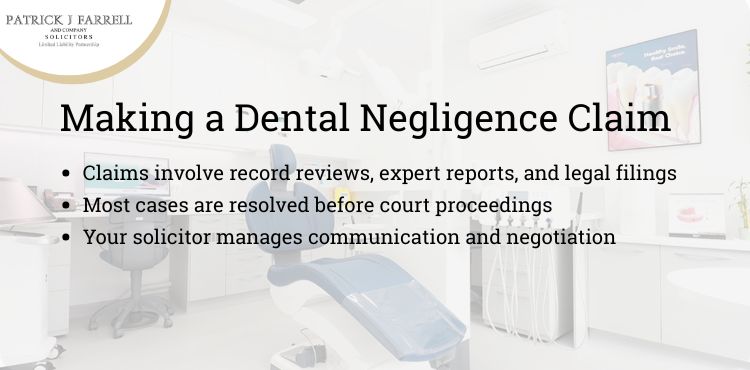
Making a dental negligence claim involves several stages, and most of them are handled by your solicitor. The process begins with an initial consultation where you explain your experience. From there, your solicitor will request your dental records and arrange for a qualified dental expert to review them.
If the expert believes the standard of care was below acceptable levels and that harm was caused, a letter of claim is drafted. This letter outlines the facts, alleges negligence, and invites the dental provider to respond. If they accept liability, the parties may negotiate a settlement. If not, the matter may be brought to court.
Your solicitor will keep you informed throughout, and most of the legal and procedural steps are handled on your behalf.
If your claim is successful, you may be entitled to compensation for the physical, emotional, and financial impact of the dental negligence. This compensation is known as “damages” and is divided into general and special categories.
General damages cover pain, suffering, and the overall effect on your quality of life. Special damages are more practical and can include reimbursement for lost earnings, corrective treatment, travel to appointments or any costs linked to the injury.
The amount depends on how serious the injury is, how long it lasted, and whether you need further treatment. Judges and insurers refer to the Personal Injuries Guidelines to help standardise payouts, though each case is still assessed individually
In some cases, the injured person may not be able to bring a claim themselves. This might be because they’re under 18, have mental health challenges, or died as a result of negligence. In these situations, someone else can bring a claim on their behalf.
Parents, guardians, or court-appointed representatives can act for minors or incapacitated adults. If someone dies, their spouse, child, or another close relative may bring a wrongful death claim. The person bringing the case will need to show a legal right to act, usually through documentation or family status.
The thought of going to court can put many people off pursuing a dental negligence claim, but the truth is that most cases are resolved without ever reaching a courtroom. In Ireland, many dental negligence claims are settled after a solicitor presents strong evidence and the other side accepts responsibility or makes a settlement offer.
That said, some cases do go to court, particularly where there is a dispute about whether negligence occurred or where there is disagreement over the amount of compensation. In such cases, your solicitor will prepare your case fully, including expert reports, witness statements, and medical records. You may be required to attend, but your solicitor will guide you through everything and represent you in front of the judge.
If the case proceeds, it is generally heard in the Circuit Court or High Court, depending on the value of the claim.
Dental negligence, like all medical negligence cases, can be sensitive, personal and often complex. At Patrick J Farrell & Co LLP, we have extensive experience helping people who’ve suffered due to medical negligence.
If you believe you were harmed due to poor dental care, it’s worth speaking to a solicitor who understands what’s involved and can give you honest, practical advice.
At Patrick J Farrell & Co Solicitors, we’re here to help. We offer clear legal guidance, expert case management, and a commitment to achieving the best outcome for you. Don’t wait until it’s too late. Contact us today to find out where you stand.
Medical Negligence Solicitor
Helen Coughlan is a partner and advises on medical negligence*, family law and personal injuries*. Helen is a qualified family mediator and collaborative law practitioner and is Chairperson of the Family and Child Law Committee of the Law Society.
Medical Negligence Solicitor
Emma Farrell is a partner and advises on medical negligence* and personal injuries*. She qualified with the largest solicitors’ firm in Ireland and has significant expertise.