
Time Limit for Medical Negligence Claims in Ireland
If you’ve suffered an injury because of a medical mistake, one of the first and most important questions you’ll face is about the timing. Irish law sets very strict deadlines for bringing a medical negligence claim, and getting to grips with these rules is essential if you want to protect your right to seek compensation.
This area of law is governed by the Statute of Limitations, and it isn’t always as simple as counting two years from the date of an incident. The key lies in a concept called the “date of knowledge,” which can change the entire timeline.
This guide will walk you through the time limits in Ireland, explain the date of knowledge rule, detail the important exceptions, and show why seeking legal advice sooner rather than later is always the best approach.
The 2-Year Time Limit For Medical Negligence Claims
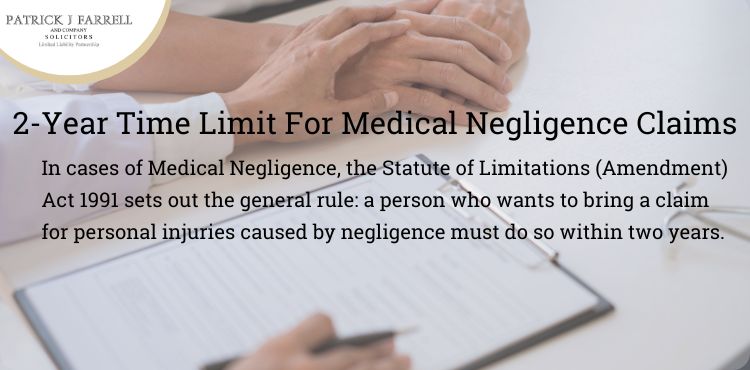
The main law governing these deadlines, the Statute of Limitations (Amendment) Act 1991 sets out the general rule: a person who wants to bring a claim for personal injuries caused by negligence must do so within two years. This two-year window is what’s known as the limitation period. If you don’t start legal proceedings within this timeframe, your claim becomes ‘statute-barred’.
This means the law permanently blocks you from pursuing it. Even if you have the strongest case in the world, a court would have no choice but to dismiss it. The most important part of this rule, however, is figuring out when that two-year clock actually starts to tick.
The Date of Knowledge Rule
The two-year clock doesn’t always start on the day the medical error happened. Instead, it begins on what the law calls the ‘date of knowledge’.
This is the date on which you first had knowledge of several key facts at once. The 1991 Act defines this as the moment you knew, or could have reasonably been expected to know, that you had suffered a significant injury, that this injury was attributable in whole or in part to a specific action or omission, and the identity of the person you believe was responsible for it.
Real-world situations show how this works. Imagine a straightforward case where a surgeon is meant to operate on a patient’s right knee but mistakenly operates on the left one. Here, the date of knowledge is clear. The patient knows right away that a significant error has occurred and who is responsible. The two-year clock starts from the date of that surgery.
But often, it’s not so clear.
For example, a patient could visit their GP with worrying symptoms but may be told that it’s nothing serious. Two years later, after seeing a specialist, they are diagnosed with an advanced form of cancer. The specialist advises them that if it had been caught when they first went to the GP, their chances of recovery would have been much higher.
In this scenario, the two-year period doesn’t run from the initial GP visit. It begins from the day the correct diagnosis was given, as this was the moment the patient became aware that the earlier failure to diagnose had caused them a significant injury.
Another common example is where a surgical instrument is accidentally left inside a patient. The patient might suffer from chronic pain and infections for years without knowing the cause. If, three years after the initial surgery, an X-ray finally reveals the forgotten instrument, their date of knowledge would be the date of that discovery. It is from that day, not the day of the surgery, that the two-year period starts.
Exceptions to the Time Limit
While the date of knowledge is the guiding principle, the law provides important exceptions for certain individuals.
Claims for Children
The law recognises that a child can’t bring a legal claim on their own. For any child who has suffered an injury due to medical negligence, such as during birth, the two-year time limit is paused. It doesn’t begin to run until they reach their 18th birthday. In practice, this means they have until their 20th birthday to formally start legal proceedings.
Claims for Persons with a Disability
If a person lacks the mental capacity to manage their own affairs and understand the legal process, the two-year limitation period is suspended. The clock will not start unless and until that person regains the capacity to handle their own affairs. If they never regain capacity, the time limit might not apply at all, though this is a complex area that requires careful legal and medical assessment.
Fatal Injury Claims
In the tragic event that a person dies as a result of medical negligence, their dependents, such as a spouse or children, may be able to bring a claim. The time limit for these claims is two years from the date of death, or two years from the date of knowledge of the dependent, whichever is later. This allows for situations where a family might not realise immediately that the death was linked to a medical error.
Why You Should Always Act Quickly
Even with the flexibility of the date of knowledge rule, it is always wise to seek legal advice as soon as you think something has gone wrong. Waiting too long can create real problems for your case.
Over time, crucial medical records can become harder to locate, and the memories of important witnesses will inevitably fade. The longer the gap between the event and the claim, the harder it can be to prove the essential link between the negligent act and the injury you suffered.
Legal processes can also take time. Properly investigating a claim, getting reports from independent medical experts and preparing a strong case can take many months. Starting the process early can give your solicitor the time needed to properly build your case without the pressure of a looming deadline.
Why Choose Patrick J. Farrell & Co.?
A solicitor’s first job is to help you establish your official date of knowledge and make sure your right to claim is protected. At Patrick J. Farrell & Co. Solicitors, our experienced team can help you manage the complex issue of time limits by reviewing the facts of your case to pinpoint when the two-year clock started.
We will gather all the necessary medical records and consult with experts to build your case. If a deadline is approaching, we will act quickly to issue the required legal documents to formally ‘stop the clock’ and preserve your right to claim. Please get in touch with us for a confidential consultation.

Helen Coughlan
Medical Negligence Solicitor
Helen Coughlan is a partner and advises on medical negligence*, family law and personal injuries*. Helen is a qualified family mediator and collaborative law practitioner and is Chairperson of the Family and Child Law Committee of the Law Society.

Emma Farrell
Medical Negligence Solicitor
Emma Farrell is a partner and advises on medical negligence* and personal injuries*. She qualified with the largest solicitors’ firm in Ireland and has significant expertise.
Medical Negligence Time Limits
Frequently Asked Questions
What is the standard time limit for a medical negligence claim in Ireland?
+
The standard time limit is two years. This period starts from your ‘date of knowledge’, or the date you first knew, or reasonably should have known, that you had suffered a significant injury due to a medical error.
Does the two-year time limit always start from when the mistake happened?
+
This is a common misunderstanding. The clock starts from your ‘date of knowledge’, which could be months or even years after the negligent act, especially in cases of misdiagnosis or where an injury takes time to appear.
What is the time limit for a medical negligence claim involving a child?
+
The two-year time limit is paused until the child’s 18th birthday, meaning they have until their 20th birthday to start a claim.
What happens if I miss the deadline?
+
If you miss the two-year deadline, your claim becomes ‘statute-barred’. This means you permanently lose the legal right to seek compensation, no matter how strong your case might have been.
Can the time limit be extended?
+
Other than the specific exceptions for children and those under a mental disability, the two-year time limit is strict and generally cannot be extended. This is why it’s so important to seek legal advice as soon as you think you have a claim.
How do I formally ‘stop the clock’ on the time limit?
+
To stop the clock, your solicitor must issue and serve a legal document called a Personal Injuries Summons on the person or institution you are claiming against. This action officially begins the legal proceedings and satisfies the time limit requirements.
More Medical Negligence Resources
Birth Injury Claims: Guide to Concerns and Compensation
Hip Replacements and Joint Replacements
How Long Does a Medical Negligence Claim Take in Ireland?
How to Prove Medical Negligence
Making a Medical Negligence Claim
Medical Negligence and Bile Duct Injuries
Medical Negligence FAQs Ireland
Plastic Surgery and Cosmetic Procedures
Sepsis Negligence Claims in Ireland
Spinal Surgery Negligence Claims Ireland
Time Limit for Medical Negligence Claims in Ireland
Understanding Healthcare-Associated Infection (HAI) Claims
What Counts as Medical Negligence in Ireland?
Will Irish Healthcare Issues Cause an Increase in Medical Negligence Claims?